If you are choosing a glb viewer workflow for downloaded assets, this review shows how Tripo and SupaVoxel exports differ in sculptural detail, geometry, textures, file weight, and delivery performance.
Independent review. I ran both tools on my own accounts, free and paid, with no vendor-provided access or early access of any kind.
My verdict in 60 seconds — Tripo 65/100, SupaVoxel 88/100
This is the article where SupaVoxel loses the visual comparison, so it goes in the first line. I put one image of a sculptural face glasses stand — an S-swept plate with a human profile carved into its left edge, on a round base — into Tripo and into SupaVoxel, then rendered both downloaded GLBs offline under identical lights and cameras, pairs side by side. Tripo holds the profile better, visibly. Tripo's nose tip resolves to a real point, its notch beneath the nose is a narrow deep V, its lip step is a hard edge, its chin undercut is a defined cut. SupaVoxel rounds the nose tip into a blunt ball, turns the notch into a shallow U, softens the lip step and curves the chin undercut. All five features — brow, nose, upper lip, lower lip, chin — stay individually readable on the SupaVoxel mesh. Every one is a grade softer. A loss, and no ratio makes it not a loss.
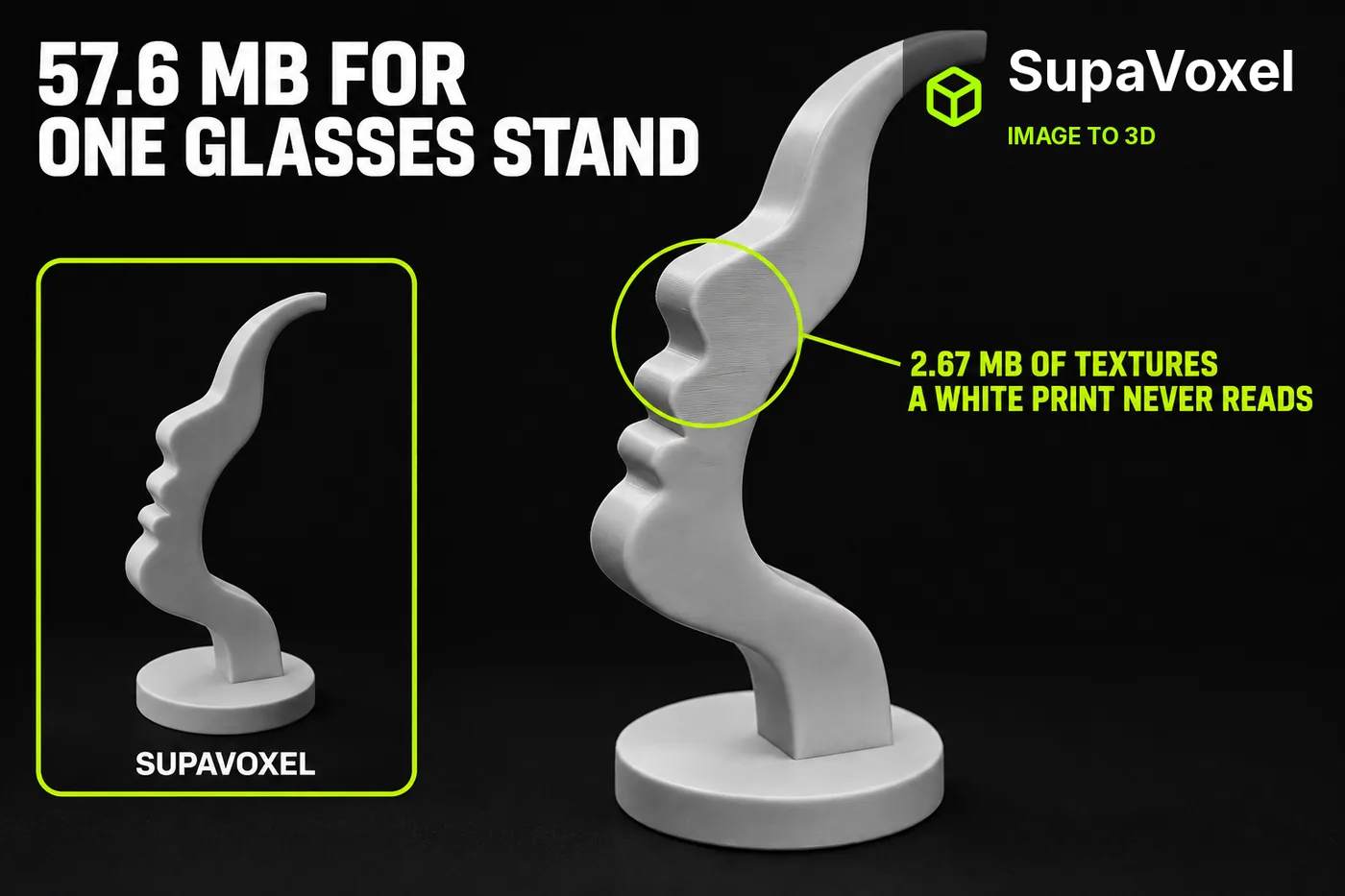
What the rest of this article measures is what that grade weighs. 57,621,648 bytes against 4,664,668.
- GLB size — Tripo 57,621,648 B (57.62 MB) · SupaVoxel 4,664,668 B (4.66 MB) · 12.4×
- Bytes per triangle — Tripo 30.39 B · SupaVoxel 4.87 B · 6.2×
- Texture set — Tripo 3 × 4096, 3,944,428 B · SupaVoxel 3 × 2048, 164,616 B · 24.0×
- baseColor map — Tripo 1,271,467 B · SupaVoxel 78,018 B · Tripo wins this row outright
- Maps a white print never reads — Tripo 2,672,961 B (67.8% of its textures) · SupaVoxel 86,598 B
- Download on 12 Mbps 4G — Tripo 38.4 s · SupaVoxel 3.1 s
- CDN at 10,000 loads/month, $0.085/GB — Tripo $48.98 · SupaVoxel $3.96
- Geometry VRAM estimate — Tripo 53.7 MB · SupaVoxel 27.2 MB
Four things that decide this case:
- The sharper nose tip is real and it is Tripo's. I show it at maximum magnification below, in the pair where the SupaVoxel loss is largest.
- It is not resolution. Tripo ships 1,896,372 triangles against SupaVoxel's 958,552 — 1.98× — and at 120 mm Tripo's mean triangle edge is 0.1339 mm against 0.1904 mm. Both already beat a 0.4 mm nozzle. The extra 937,820 triangles do not resolve the notch; a harder crease does.
- 67.8% of Tripo's texture payload is metallicRoughness and normal maps: on a white printed part, 2,672,961 bytes you download and delete.
- Neither product invented the back half. No ears, no hair, no skull either side. 55 Tripo credits bought nothing on the half the camera never saw.
Coloured render or product image? Tripo's 4K basecolor and harder edges are worth buying, and I say so again at the end. A file that has to move — into a browser, across 4G, off a CDN? You are paying 12.4× the bytes for one nose tip.
The test: one image, two exports, one set of cameras
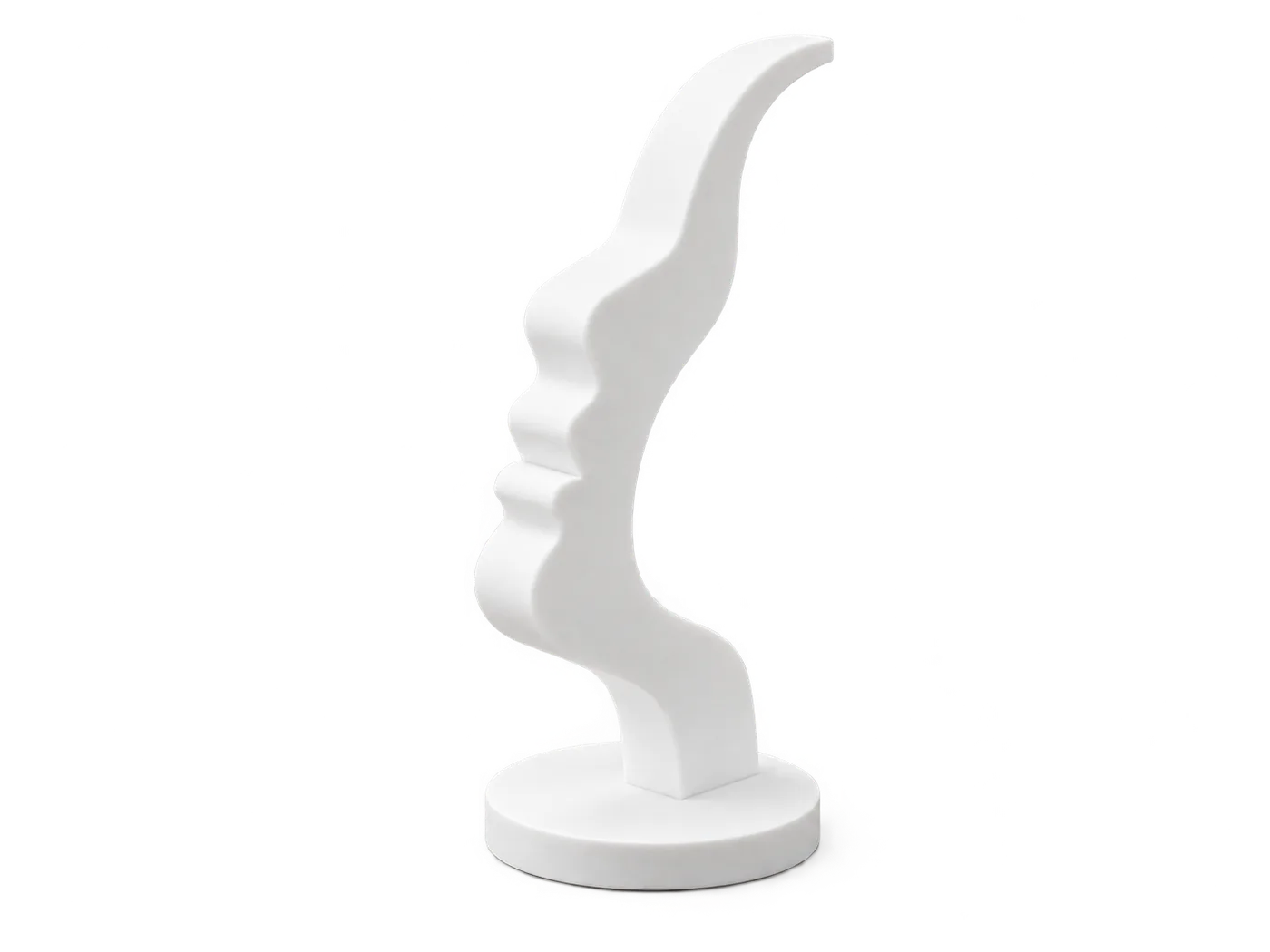
The single input both products received: a 359,638-byte PNG, sha256 0f736f93…. Two things about the subject. The plate is a deliberate S-shaped sweep, not a flat slab — the front-back variation you see is the design. And the reference shows the stand empty: on this design the carved nose is the crossbar the glasses rest on, so no separate bar in frame is correct.
The two exports land in different world orientations, so my offline render script offsets each one by its own yaw. Every pair below is genuinely the same viewing angle, not two flattering picks. Same lights, same lens, same background.
The pair that decides it: Tripo's nose tip is sharper
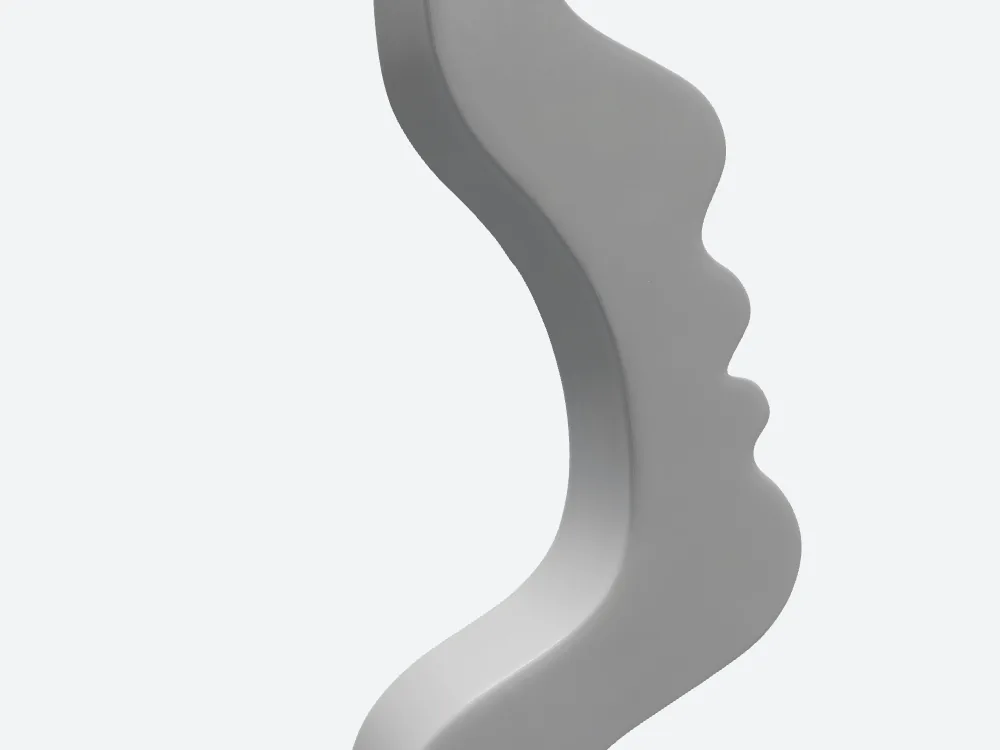
Tripo at maximum magnification along the carved edge: nose tip an actual point, notch a narrow V, a hard step between the lips, a defined undercut below the chin. The most honest image in this comparison — better than SupaVoxel's, needing no explanation.
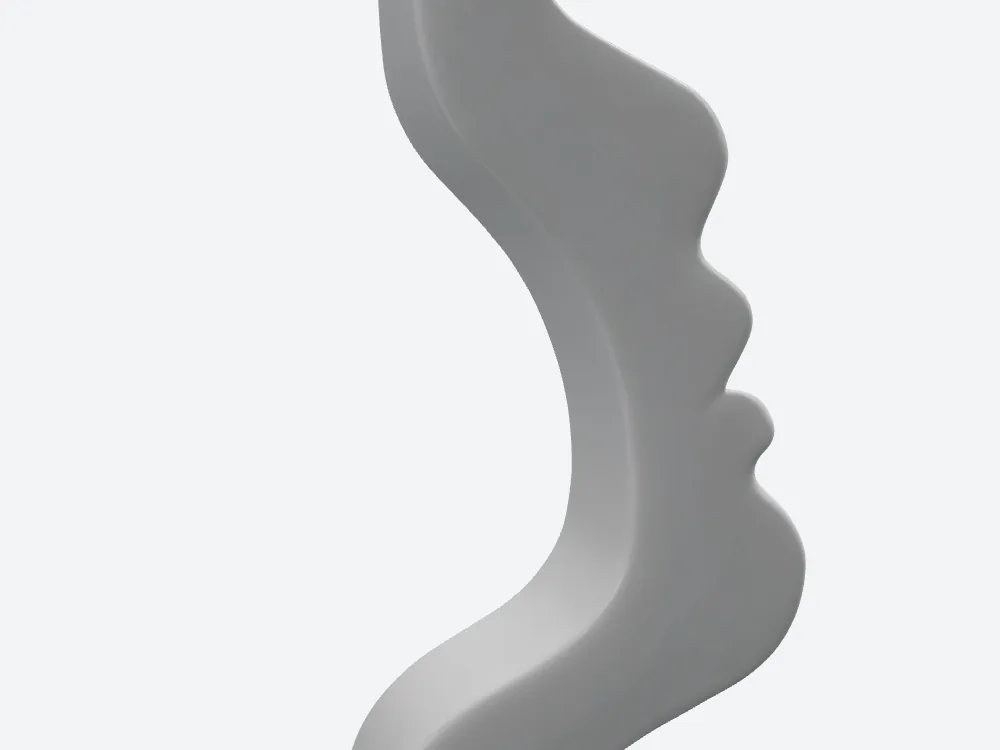
SupaVoxel, same position and magnification. Forehead into nose bridge runs smooth, then the nose tip closes into a blunt ball. The notch is a shallow U, the lips read as soft pads rather than a step, the chin undercut is an arc. All five features present, all five softer.
- Nose tip — Tripo point · SupaVoxel rounded ball
- Notch under the nose — Tripo narrow deep V · SupaVoxel shallow U
- Lip step — Tripo hard edge · SupaVoxel soft pads
- Chin undercut — Tripo defined cut · SupaVoxel arc
- What it cost to buy that — 52 extra credits and 52,956,980 extra bytes, on a mesh whose winding still comes back inverted
That last line is the trade ratio, and the reason this case is close rather than decided. Tripo is better here — better by an amount you can see at 120 mm if you lean in — and Tripo charges 18.3× credits and 12.4× bytes for it.
The silhouette pair, at the size where the loss is biggest
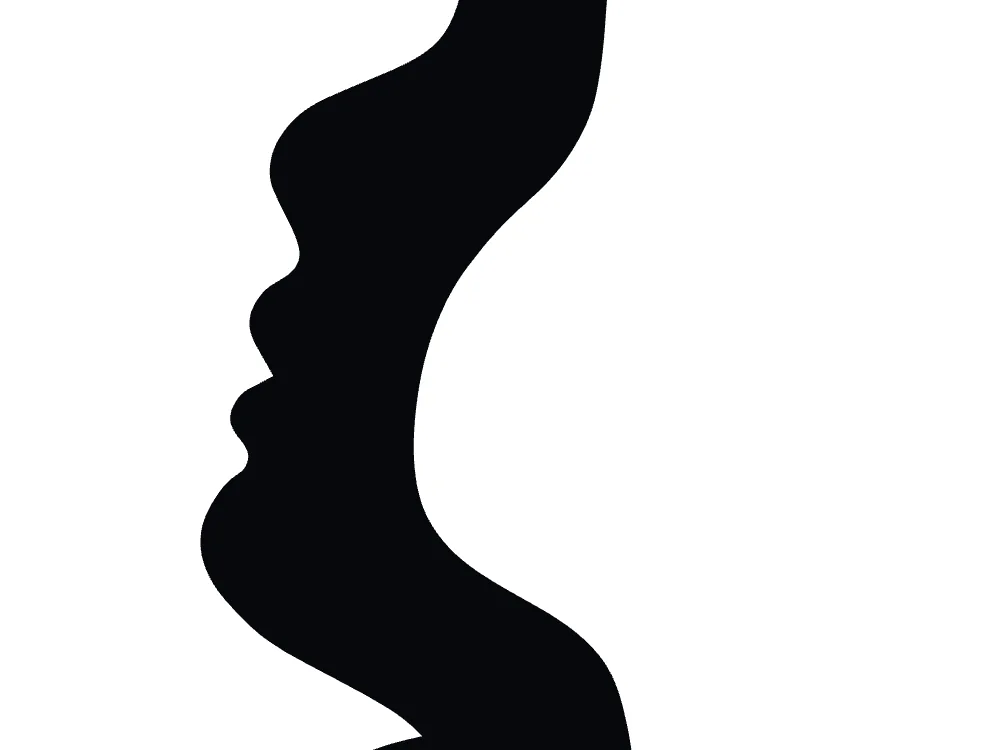
Tripo's wireframe at 1,896,372 faces renders as a black mass — worthless as wireframe evidence, and I will not argue topology from it. As a silhouette it is the sharpest thing in this article: pointed nose, narrow V notch, right-angle lip step.
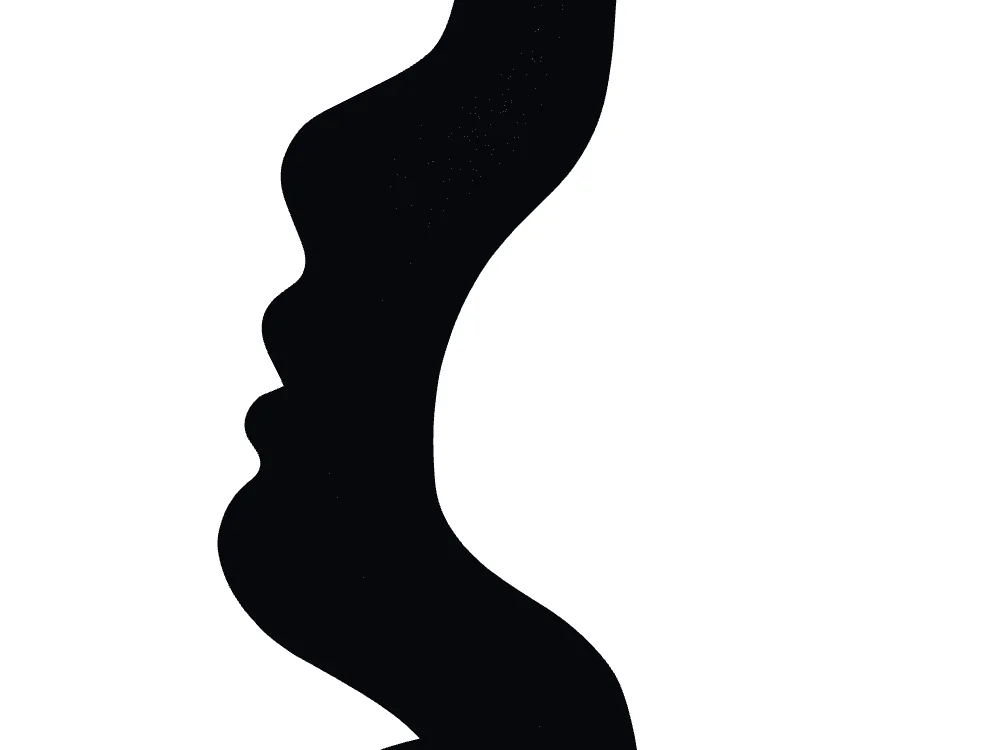
SupaVoxel at 958,552 faces, same black mass, same silhouette-only reading: round nose tip, shallow notch, soft lip step.
I kept this pair because it magnifies the defeat rather than hiding it. Do not read edge flow from either image — at these face counts there is none to read.
Where the 57.6 MB actually goes
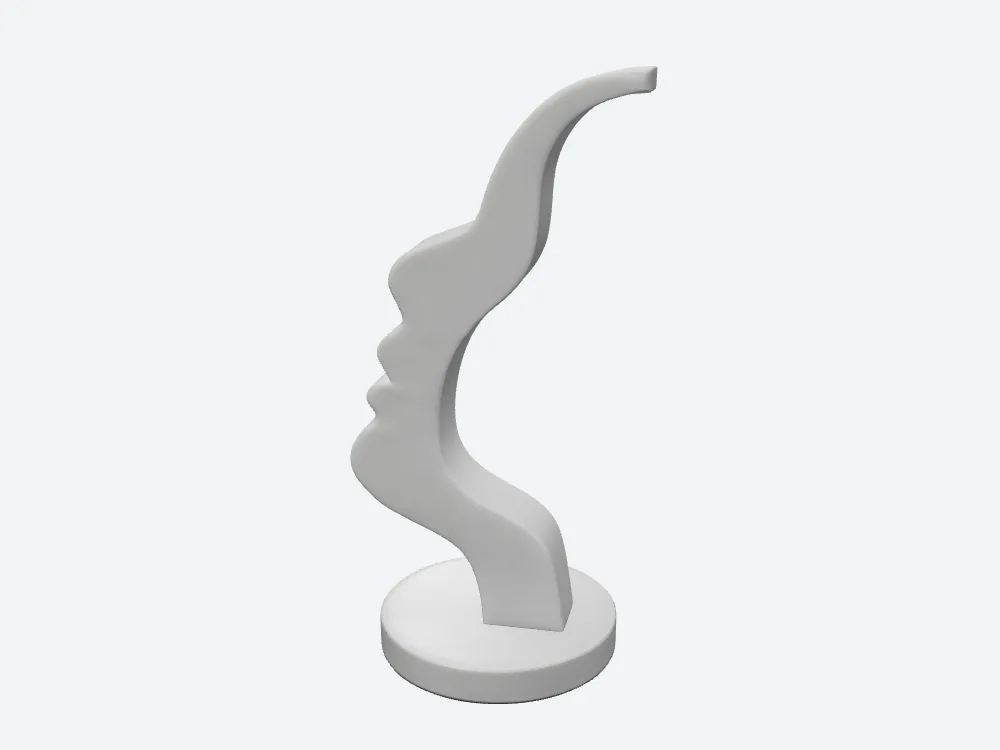
Tripo under the key light: 1,896,372 faces, 57,621,648 B, three 4096² textures totalling 3,944,428 B. Faint horizontal banding runs across the plate face and the base disc rim.
- Geometry + everything else — 57,621,648 B total, of which 3,944,428 B is texture
- Bytes per triangle — 30.39 B against SupaVoxel's 4.87 B
- glTF extensions used — Tripo
KHR_materials_volume,FB_ngon_encoding;extensions_requiredempty - SupaVoxel —
EXT_meshopt_compressionandKHR_mesh_quantization, both inextensions_required
That last row is a real mark against SupaVoxel and belongs here, not in a footnote. Tripo's file requires nothing, so it opens anywhere; SupaVoxel's requires two extensions, so an older viewer can fail and you validate before shipping. The 6.2× gap in bytes per triangle is largely those extensions doing their job — 958,552 faces and three 2048² textures inside 4.66 MB — and the price is one compatibility check.
The SupaVoxel file, same light, same camera
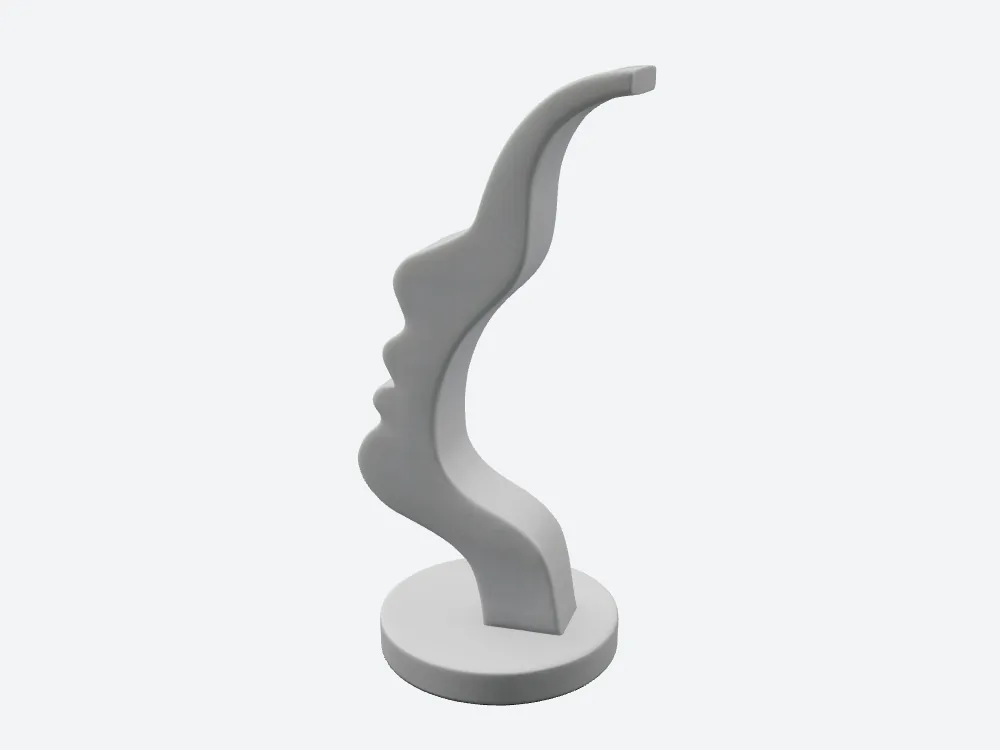
SupaVoxel under the identical key light: 958,552 faces, 4,664,668 B, three 2048² textures totalling 164,616 B. As a white part the plate is clean — no undulation, no seam glare.
- Triangles — Tripo 1,896,372 · SupaVoxel 958,552 · 50.5% of Tripo's count
- Vertices — Tripo 966,210 · SupaVoxel 490,680
- Extra triangles Tripo ships — 937,820 · new features they buy in this white render: none visible
- What they do buy — the sharper nose crease, and that faint horizontal banding across the plate face
Nearly a million extra triangles, and the visible return is one crease sharper on one edge, plus banding the other surface does not have. Those triangles are not worthless — they are where Tripo's crease came from. The exchange rate is what is bad.
Texture bytes: the row Tripo wins, and the row it loses
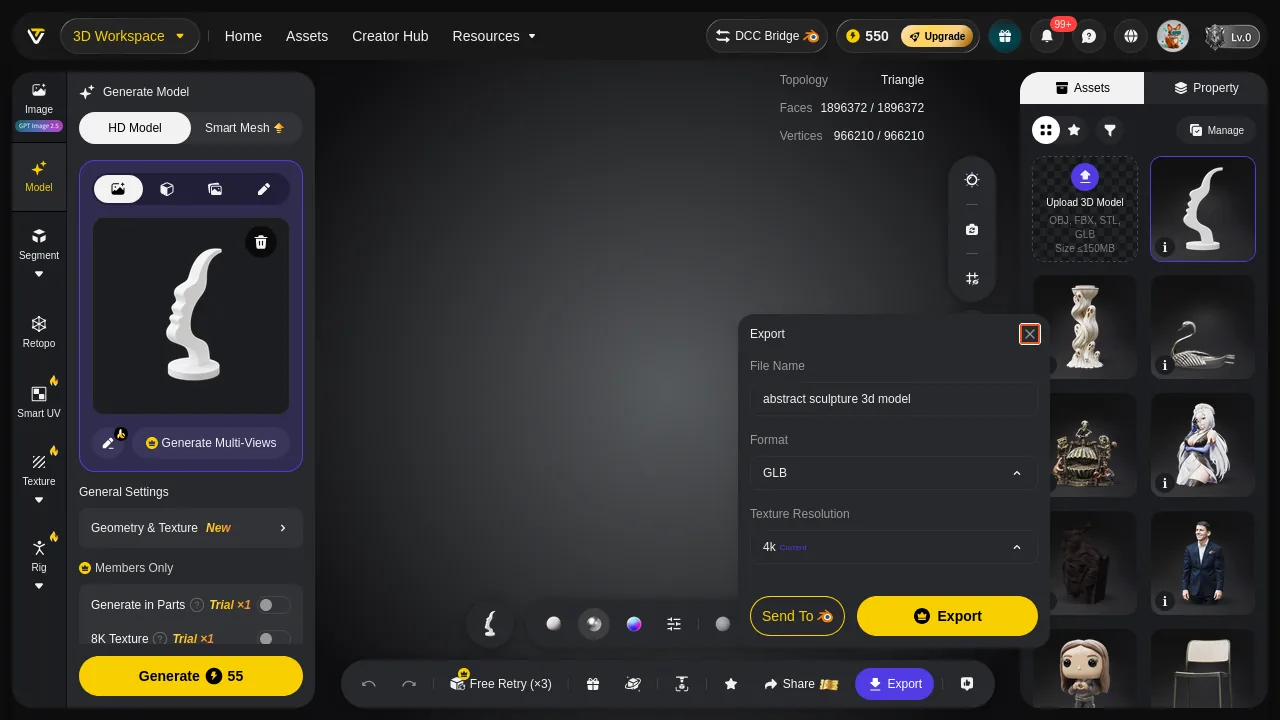
Tripo's export dialog. Texture Resolution defaults to 4k (Current). That default is where most of the 57.62 MB comes from.
Won by Tripo:
- baseColor — Tripo 4096², 1,271,467 B · SupaVoxel 2048², 78,018 B · 16.3× more colour data
If you are going to light, colour or re-render this model, that is genuine material and SupaVoxel does not match it.
Lost by Tripo:
- metallicRoughness + normal — Tripo 2,672,961 B · SupaVoxel 86,598 B
- Share of Tripo's texture payload that a white print never reads — 67.8%
- Total texture bytes — Tripo 3,944,428 B · SupaVoxel 164,616 B · 24.0×
So Tripo attaches 3.94 MB of maps, of which 2.67 MB goes inert the moment the output is a white part. SupaVoxel attaches 0.16 MB. Which is right depends entirely on your output, and this is the row where I genuinely tell some readers to choose Tripo.
Same-camera sweep: everything except the profile is a tie
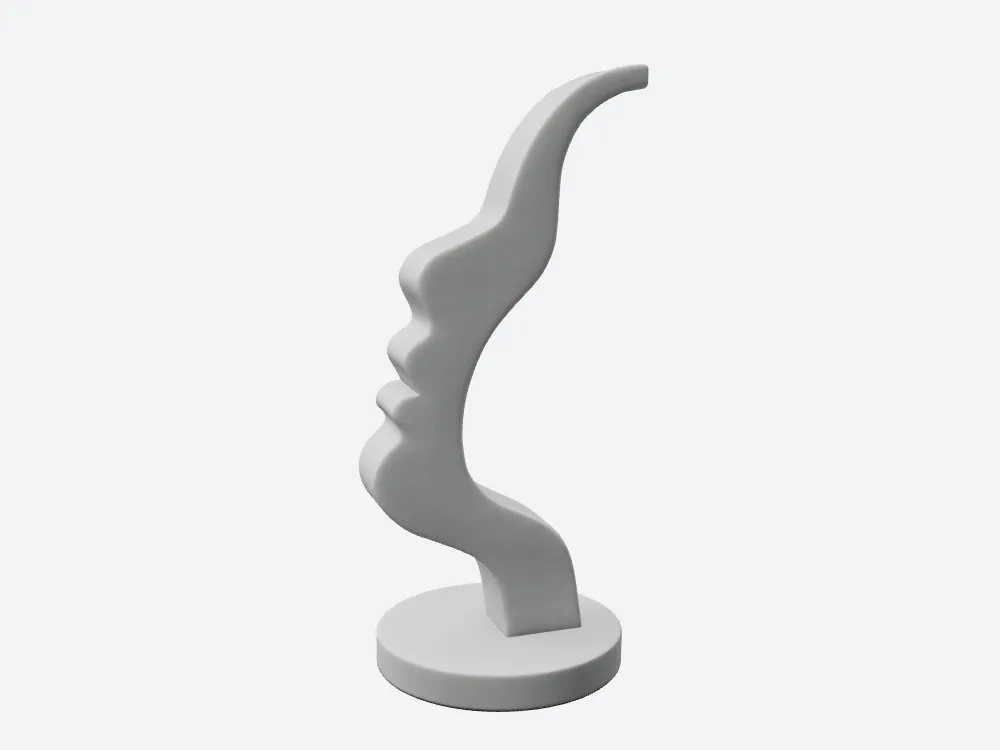
SupaVoxel from the front. Brow, nose, upper lip, lower lip and chin read as separate forms, nothing collapsed into a lump. The nose tip is round.
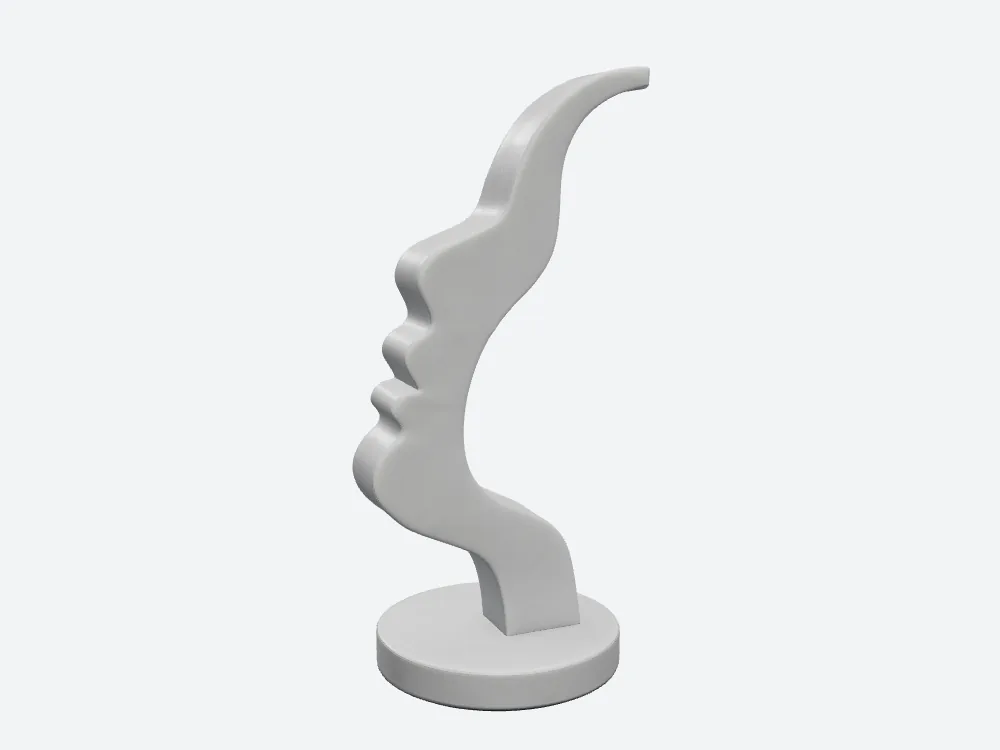
Tripo from the front, same camera. Pointed nose tip, deeper narrower notch, harder lip step. And along the plate face and base disc edge, a faint horizontal ripple the other surface does not have.
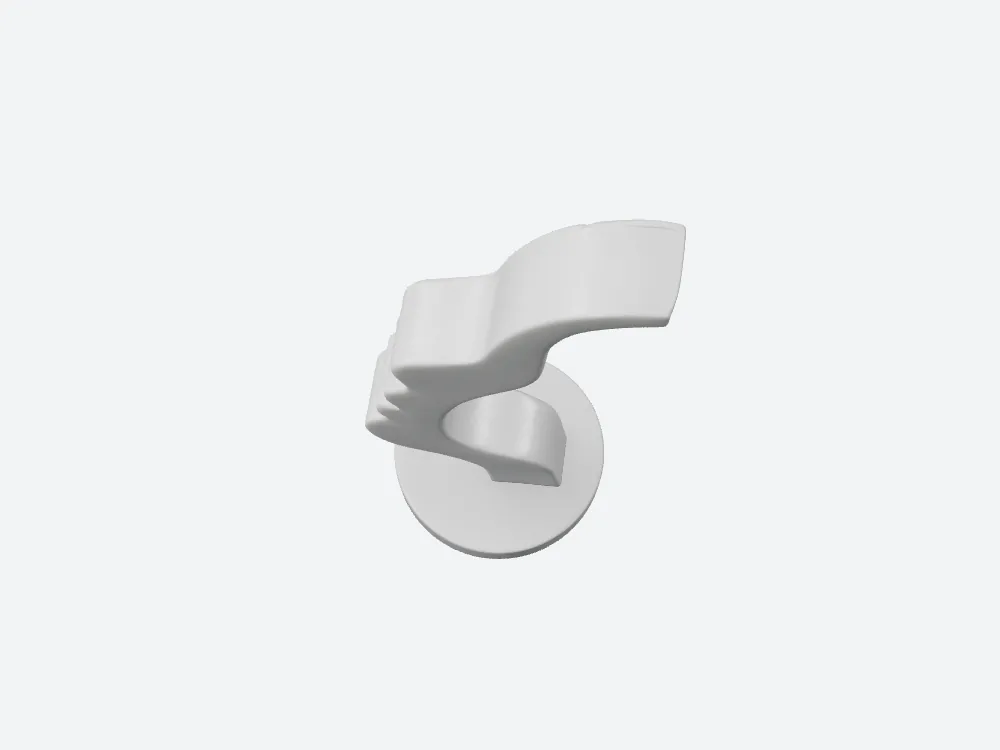
Top view, SupaVoxel. The plate reaches past the disc; the three notches along the carved edge — under the nose, between the lips, under the chin — read from above, just rounder and wider.
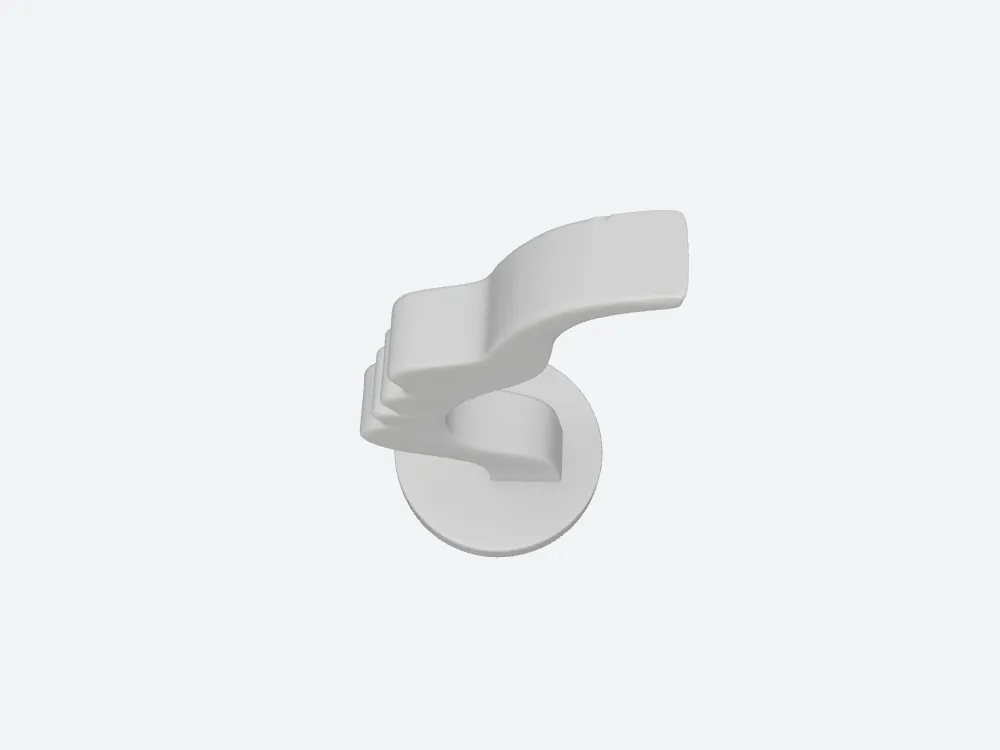
Top view, Tripo, same camera. The footprints all but overlap — 50.6 × 56.24 mm against 57.9 × 50.07 mm, the same shape rotated 90° — and Tripo's three notches are narrower and sharper. Same story, fourth angle.
The geometry underneath the profile is the same object twice:
- Solid volume at 120 mm tall — Tripo 43.67 cm³ · SupaVoxel 44.79 cm³ · 2.6% apart
- Cross-section depth, 13 height bands — within about 1 mm at 10 of 13
- Base disc roundness error — Tripo 0.8% · SupaVoxel 0.4% · 0.2 mm on a 25.2 mm mean rim radius
- Bottom face flatness — Tripo 0.796 mm · SupaVoxel 0.798 mm
Both backs are empty, and that is the fair result
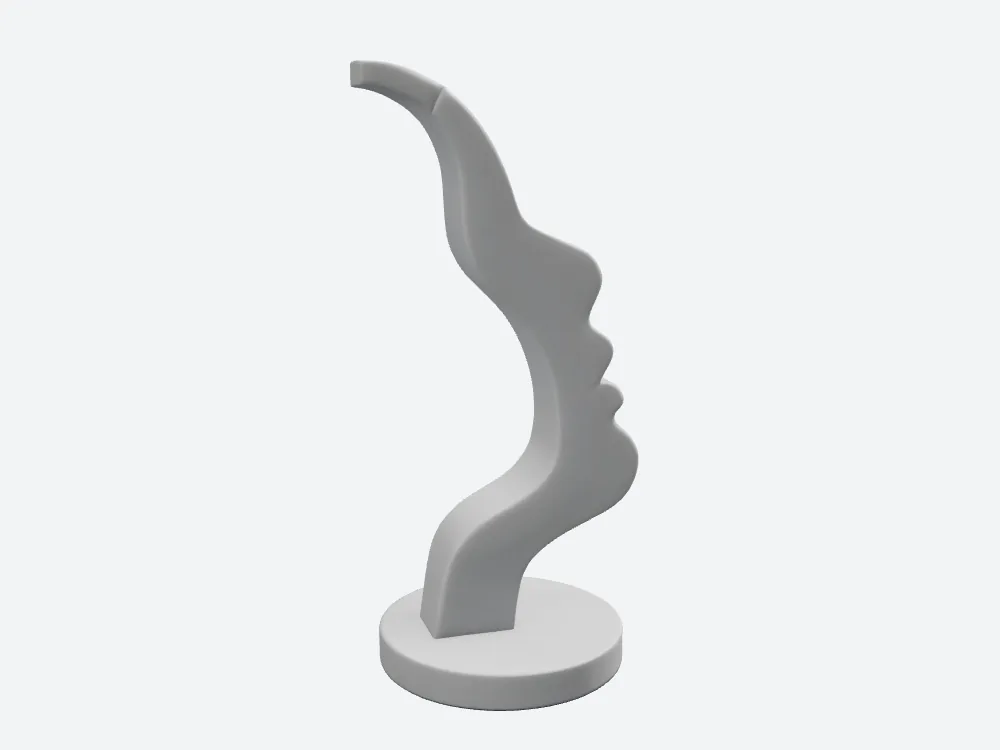
SupaVoxel from behind — the half the input never showed. Nothing invented: no ears, no hair, no skull, just the profile swept through the plate and closed with a smooth rear arc. The faint seam on the upper hook is real; the printability article covers the topology count behind it.
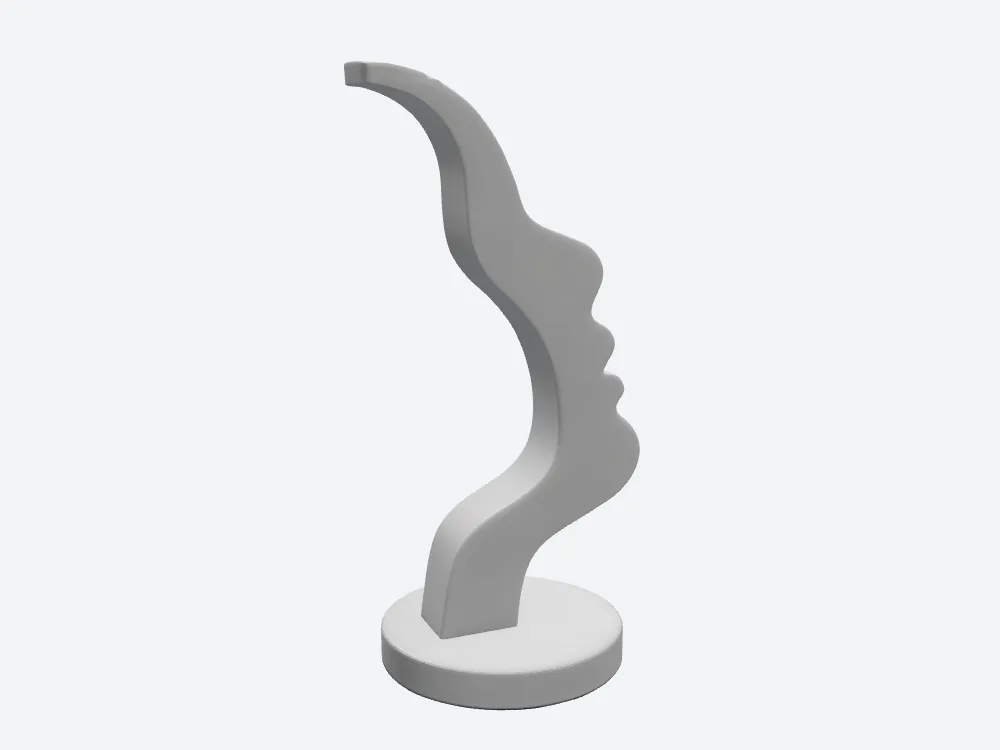
Tripo from behind, same camera, same answer. No ears, no hair, no skull. Its rear arc carries a few shallow undulations the other does not.
Neither product hallucinated. On the one part of the object where a generative tool has room to invent, both declined, and Tripo's 55 credits bought no more imagination than the other file's 3.
What 12.4× costs when the file has to move
Bytes stop being an abstraction the moment the model leaves your disk:
- 12 Mbps 4G, one file — Tripo 38.4 s · SupaVoxel 3.1 s · 35.3 s of difference per view
- 100 Mbps home, one file — Tripo 4.6 s · SupaVoxel 0.37 s
- CDN at 10,000 loads/month, $0.085/GB — Tripo $48.98 · SupaVoxel $3.96 · $45.02/month
- Geometry VRAM — Tripo 53.7 MB · SupaVoxel 27.2 MB (vertices × 32 B + indices × 4 B, textures excluded)
- A batch of 100, total download — Tripo 5.76 GB · SupaVoxel 0.47 GB
Put Tripo's 57.62 MB on a product page and a phone visitor stares at a spinner for 38 seconds — the sharper nose tip arriving one nose tip at a time, at $48.98 a month per ten thousand views.
Both product panels told the truth about their own numbers
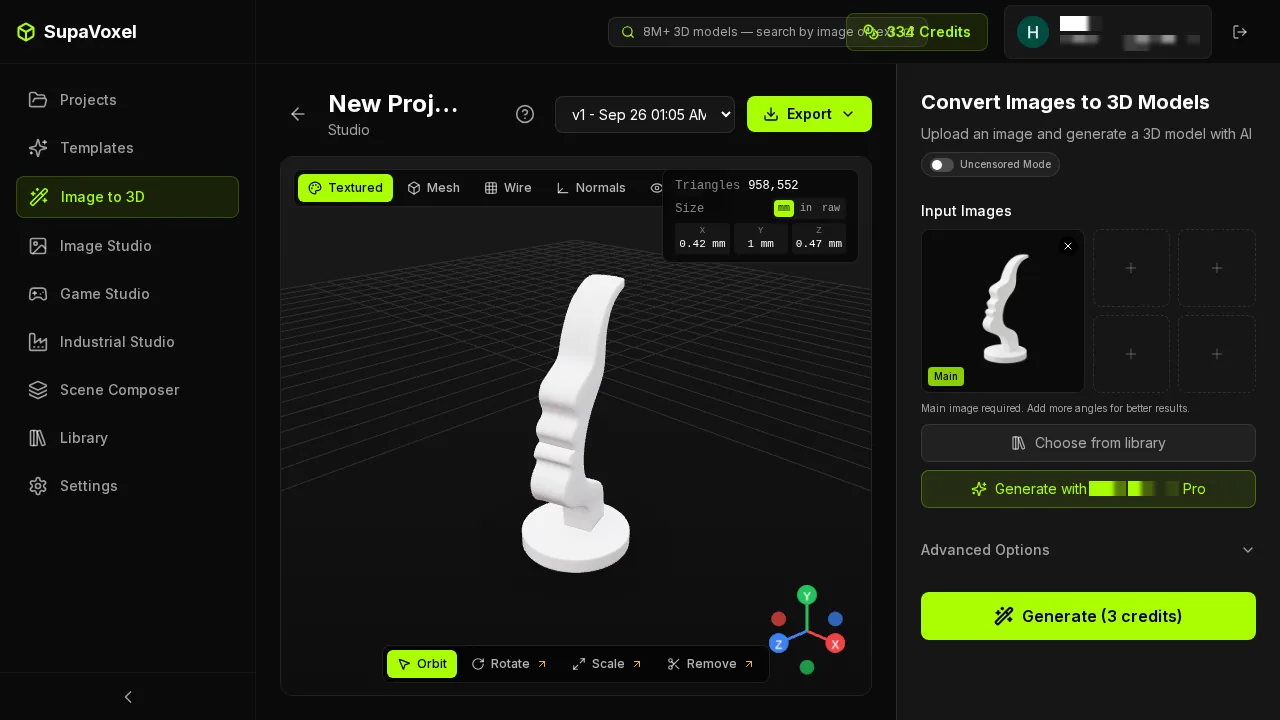
SupaVoxel's result page reports Triangles 958,552; the parsed GLB reports 958,552. Four inspection modes sit side by side — Textured / Mesh / Wire / Normals — and the size readout below carries mm / in / raw.
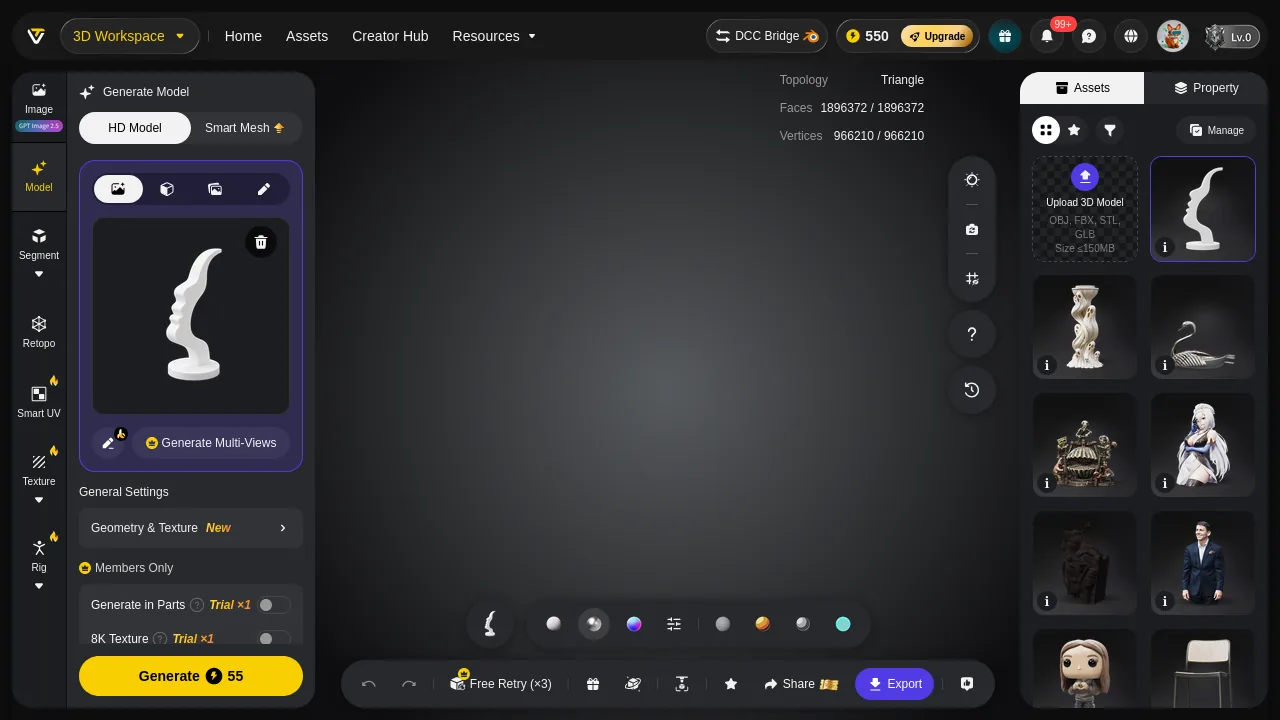
Tripo's completion screen reports Triangle / Faces 1896372 and Vertices 966210. Also exact against the parsed GLB.
Neither panel inflated anything, which deserves saying in a category where panel numbers are often decorative. What they do not tell you is unequal: SupaVoxel has a Normals mode and a version selector, Tripo a material strip. Not captured either side: the export format list — both exported GLB only — and the SupaVoxel export click count.
Final verdict: Tripo scores 65, and it earned the profile row
Tripo produced the better-looking model of this subject. Nose tip, notch, lip step, chin undercut — four features, four wins, visible at magnification with no measurement. Tripo's 4K basecolor carries 16.3× the colour data, its file requires no glTF extensions, its panel numbers are exact. All of that has its own space above, not a line of regret at the bottom.
The bill is 57,621,648 bytes against 4,664,668 — 12.4× — and 55 credits against 3. Underneath the profile these are the same object: 2.6% apart in volume, within about 1 mm at 10 of 13 depth bands, two true circular bases, two flat bottoms. Nearly a million extra triangles a 0.4 mm nozzle cannot cash. 2,672,961 bytes of maps a white print never reads. And on a phone, 38.4 seconds against 3.1.
Use Tripo when the output is coloured — a render, a product shot, an asset that gets lit — and you want the 4K basecolor and the harder edges, and neither the credits nor the megabytes are constrained.
Use SupaVoxel when the file has to move, or when there is more than one of them.
Which one I would use for this job
If the file has to move, I would ship the 4.66 MB one: 3 credits, three 2048² textures, 3.1 seconds on 4G against Tripo's 38.4, and $3.96 a month on a CDN against $48.98. Its nose tip is rounder — the trade, stated in the first line and unmoved. I would also validate its two required glTF extensions against the target viewer before shipping; that caveat is real. supavoxel.com is where I ran that half of the test.
Originally published on Medium: Tripo GLB Export Review 2026: 57.6 MB for One Glasses Stand.